



The Alberta government has lifted habitat protections for one of Canada’s most threatened species, the greater sage grouse.
In July, amendments to the Public Lands Act resulted in the removal of protections for the greater sage grouse within designated recovery and protection areas. Coincidentally, that same month, Thor Resources, a helium extraction company, received approval for a project in an area designated as greater sage grouse habitat.
Both the Alberta and federal governments classify the greater sage grouse as an endangered species. Current estimates indicate that fewer than 100 individuals remain in Alberta, with the population confined to the province’s southeastern region.
The greater sage grouse suffered a 98 percent decline in population in Alberta between 1968 and 2012, primarily due to habitat destruction and industrial expansion. Today, the species inhabits merely about seven percent of its historical territory.
Mark Boyce, an ecology professor at the University of Alberta who has been involved in greater sage grouse conservation since 1977, asserts that the removal of provincial protections directly threatens the survival of the remaining Alberta sage grouse population.
“The province shows no concern,” Boyce stated. “We’re on the brink of losing the most endangered vertebrate species in Canada because of this decision.”
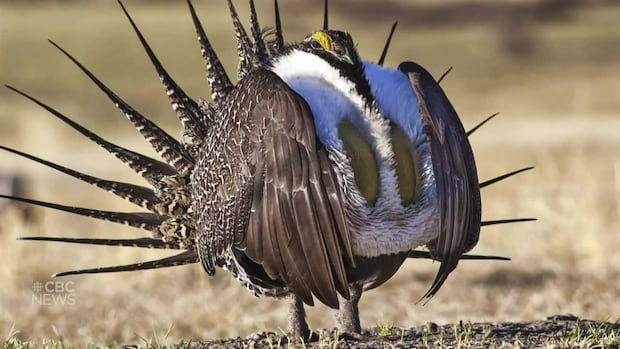
An iconic bird known for its unique mating ritual is at risk of disappearing from Western Canada. Once numbering in the thousands, fewer than 100 of the round-bodied birds remain in Alberta and Saskatchewan as their habitat shrinks
Boyce highlighted that sage grouse are particularly susceptible to development pressures. They often vacate their habitats due to noise and traffic disturbances, while human-made structures provide unnatural hunting perches for predators like eagles and owls that threaten the endangered species.
“It’s typical for the province of Alberta to prioritize industrial growth over conservation,” Boyce commented.
“I fear the birds are doomed,” he expressed. “I believe we are going to lose them entirely.”
Province’s plan ‘balances conservation outcomes with the needs of a changing province and economy’
In a statement to CBC News, Andrew Livingstone, communications director for Alberta Environment and Protected Areas, explained that the adjustments were made “to simplify regulatory requirements in sage grouse ranges and to provide more flexibility and clarity for operators in southeastern Alberta.”
“Alberta remains committed to a sage grouse recovery program aimed at delivering an effective solution that harmonizes conservation goals with the evolving needs of the province and its economy,” he stated.
Livingstone noted that the province is enhancing and expanding recovery efforts, which include programs for brood and nest augmentation, habitat restoration, predator management, partnerships for stewardship, and improved monitoring.
“Alberta will continue collaborating with industry and local partners to promote responsible resource development while fostering the recovery of this endangered species,” he added.
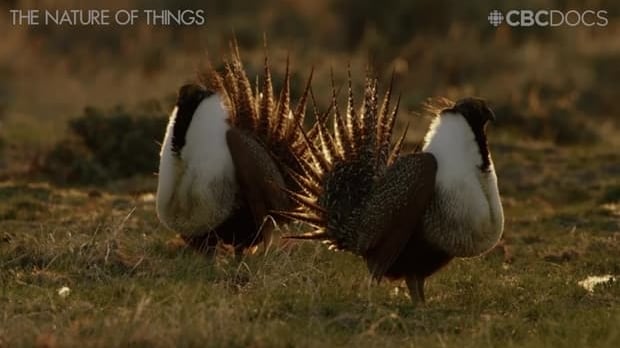
Each spring, endangered sage grouse males gather on ‘leks,’ performing grounds where they hope to dazzle females with their display and other-worldly mating call.
Joshua Killeen, conservation science and program manager for the Canadian Parks and Wilderness Society’s southern Alberta chapter, remarked that the lifting of provincial habitat protections jeopardizes years of efforts aimed at aiding the species’ recovery.
“With these recent changes, it appears that all the progress made over the years is now at risk. The absence of habitat protection significantly diminishes the species’ chances of survival,” Killeen stated.
“They are extremely vulnerable to extinction in Alberta and potentially across Canada,” he warned.
- Grassland birds in crisis on the Canadian Prairies, conservationists warn
- ‘Conservation success story’: Endangered whooping crane makes rare appearance in central Alberta
Federal protections for approximately 25 percent of Alberta’s greater sage grouse habitat remain intact. The federal emergency order, effective since 2014, is currently the only active order of its kind in the province and one of just two ever issued.
“While that emergency order remains in effect, the provincial regulations encompassed a much broader area of the habitat,” Killeen noted. “Without those regulations, we’re left with exclusively federal protection, which is a significant setback for the species.”
Helium industry pushed for provincial protections to be removed
Thor Resources, the helium extraction firm that received approval for a project in designated greater sage grouse habitat in the same month the provincial protections were lifted, listed various sensitive wildlife surveys on its application. However, the list did not include the greater sage grouse.
Brent Jonah, CEO of Thor Resources, mentioned that when the company obtained its mineral rights over ten years ago, the provincial recovery area had not yet been established, meaning they were not originally in greater sage grouse territory.
Jonah stated that while the helium site will continue to adhere to previous protections by keeping structures below 1.2 meters in height and implementing noise mitigation measures, “there are no specific requirements I need to follow in these areas” regarding the greater sage grouse anymore.
- Surging prices provide ‘adrenaline shot’ for Canadian helium industry
- Helium startups on the Prairies hope to keep domestic supplies afloat
Richard Dunn, executive director of the Helium Developers Association of Canada, revealed that his organization had repeatedly requested the province to consider amending those habitat protections.
He stated that the provincial safeguards were overly restrictive, and that their removal is a part of “the necessity to balance environmental factors with economic development and social considerations.”
“If access to these areas is restricted for six to nine months each year, it becomes evident that economic development cannot occur,” he explained, referring to the previous requirement that sagebrush plants, native grasses, and native forbs not be disturbed or removed in designated greater sage grouse habitats.
Tag: rewrite-pending