



In the wake of unsuccessful trade negotiations with the Trump administration, the Liberal government is introducing a $7.5 billion initiative aimed at assisting workers and businesses in coping with the new 50 percent tariffs that President Trump is imposing on $27.6 billion worth of Canadian goods.
On Tuesday, Finance Minister François-Philippe Champagne and other officials revealed that the government will implement countermeasures starting September 8, matching the U.S. tariffs dollar for dollar by imposing tariffs on an equivalent $27.6 billion of U.S. goods.
“This is an extraordinary challenge for Canada, but we will rise to the occasion, and Canadians will unite to face this challenge together,” Champagne stated during an announcement at a roofing firm in Ottawa.
“We are committed to supporting our workers, businesses, and industries for as long as necessary and with whatever means required.”
Earlier, officials indicated that this support package is in addition to the nearly $25 billion in tariff assistance provided over the last 18 months.
The designed measures aim to prioritize aid for workers and businesses, especially small and medium-sized enterprises throughout Canada, according to officials.
Support for Workers and Small Enterprises
As part of the support initiative, the Liberal government is allocating $3.5 billion from the $7.5 billion package to a rapid response program for workers and employers.
Some of these funds will be used to extend three changes to Employment Insurance (EI) that were first announced in September 2025 and were set to expire on October 10, which include:
- Extending the one-week waiting period waiver for EI recipients for another year.
- Allowing workers to collect EI benefits without depleting their separation payments until October 10, 2027.
- Providing an additional 20 weeks of EI benefits to long-tenured employees until June 2027.
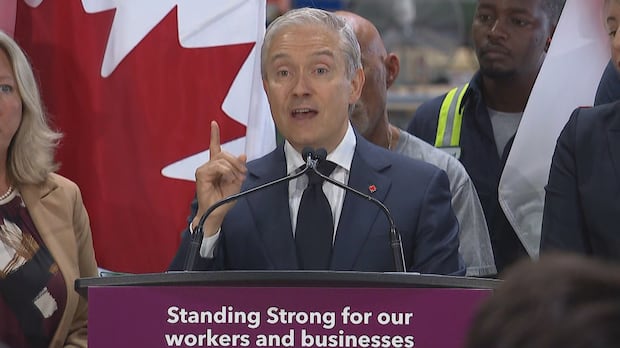
Finance Minister François-Philippe Champagne indicates that Canada will respond to the latest U.S. tariffs in a ‘proportionate, targeted, and strategic’ manner, asserting that the tariffs affecting over $27 billion in U.S. goods are about ‘fairness.’
Two additional initiatives being introduced will permit workers who have voluntarily resigned to claim EI benefits without penalty, and will assist in connecting unemployed or underemployed individuals with major projects requiring staff.
Employers will receive up to $1,000 per employee to offset the training and administrative expenses related to EI work-sharing and retention programs.
This program enables employers to reduce a worker’s schedule from five days to two, allowing employees to collect EI for the remaining three days at 70 percent of their salary, as opposed to the usual 55 percent.
“Maintaining skilled workers during downturns allows businesses to keep their talent, and it aids employees in navigating challenging periods for their employers,” commented Minister of Jobs and Families Patty Hajdu.
Financing and Loans
Additionally, the government is investing $2 billion to establish the Canada Strong Diversification Fund, which will “assist companies affected by tariffs with ready-to-go projects that support ongoing capital maintenance, including medium-sized businesses.”
Larger companies will benefit from increased flexibility due to adjustments made to the Large Enterprise Tariff Loan facility (LETL).
-
What we know about how the Canada-U.S. trade talks fell apart
-
Trump says idea of him interfering with Canadians speaking French is a ‘stupid thing’
Originally announced in March 2025, the LETL grants eligible companies 24 months of financial liquidity. Under the new support plan, this period is being extended to 36 months, and the maximum loan repayment timeframe is increased from 10 to 15 years.
Medium-sized enterprises nationwide will also have access to an additional $1.5 billion in funding via one of Canada’s seven regional development agencies.
This extra funding raises the cap on non-repayable grants to $3 million from $1 million. Additionally, interest-free loans of up to $2 million will be available for qualifying businesses.
Industry Minister Mélanie Joly stated that these programs will be open to businesses generating more than $1 million in revenue.

At Issue special edition: Canada-U.S. trade talks collapse and President Donald Trump threatens even more tariffs. Was it the right decision for Prime Minister Mark Carney’s government to walk away and is a deal still possible?
The Business Development Bank of Canada will have an additional $500 million liquidity stream to provide working capital support for small and medium-sized enterprises facing financial challenges.
Companies directly affected by the tariffs can apply for loans ranging from $250,000 to $5 million, with the option to make interest-only payments for 36 months, extending beyond the conclusion of Trump’s second term.
Canada’s New Retaliatory Tariff Framework
The retaliatory tariffs will affect the same products that the Trump administration targeted when it imposed Section 338 and 232 tariffs on Canada. A comprehensive list of the over 700 products affected is available online.
President Trump’s Section 232 tariffs, which range from 10 to 50 percent, were applied to steel, aluminum, copper, automobiles, lumber, their derivatives, and certain semiconductors.
The 338 tariffs encompass various Canadian goods, including hockey sticks, alcohol, and dairy products, which were implemented following the breakdown of trade discussions between the two nations.
Officials noted that Canada’s tariff strategy aims to shield domestic industries rather than generate revenue. To achieve this, Canada will match the U.S. tariff rate on the corresponding products.
Ministers indicated that they have strategically selected U.S. products for tariffs based on the availability of Canadian alternatives.
Earlier on Tuesday, Prime Minister Mark Carney held discussions with federal opposition leaders to brief them on the government’s reaction to President Trump’s latest tariff escalations.
“The prime minister and the opposition leaders focused on the ongoing response and emphasized the necessity of a united Team Canada approach as we work to safeguard jobs, bolster the economy, and advocate for Canadian interests,” a statement from the Prime Minister’s Office read.
NDP Leader Avi Lewis expressed to CBC’s Power & Politics that he made it clear to Carney that his party backed the decision to “walk away” from negotiations. Lewis strongly advocated for additional measures, such as implementing export taxes on oil and gas to exert pressure on the U.S.
“We are confronting a relentless opponent in these negotiations, and the New Democrats want to see the government assert the leverage we possess as Canada,” Lewis stated.
Following the meeting, Conservative Leader Pierre Poilievre released a statement calling for Carney to publish the text of the rejected agreement, reconvene Parliament, and “implement an emergency economic action plan to preserve jobs and reduce costs for our citizens.”
This proposed plan would necessitate the government to eliminate all gas taxes until the next Canada Day, exempt individuals reinvesting in Canada from capital gains taxes, and pursue other initiatives that the Conservatives promised during their last federal election campaign.
Joly dismissed Poilievre’s requests, asserting that the Conservative leader has consistently opposed Liberal efforts to assist workers and businesses.
“I would advise Mr. Poilievre to practice what he preaches,” Joly remarked.