



Prime Minister Mark Carney announced that the federal government plans to invest $11.3 billion into Quebec’s shipbuilding sector, aiming to construct six new icebreakers for the Canadian Coast Guard.
Carney referred to this initiative as the “largest” shipbuilding contract recorded in the history of the province.
The new icebreakers will take the place of the Coast Guard’s outdated heavy and medium icebreakers, fulfilling a commitment made back in 2019.
“We will act swiftly. The initial steel will be cut next autumn, the first vessel will be delivered in five years, and the complete fleet will be operational five years after that,” Carney stated.
“These ships will operate in Atlantic Canada, navigate the St. Lawrence during the coldest months, and serve in our Arctic during the summer months.”
Carney made this declaration alongside Quebec Premier Christine Fréchette at the Chantier Davie shipyard located in Lévis, Quebec, where all six vessels will be built.
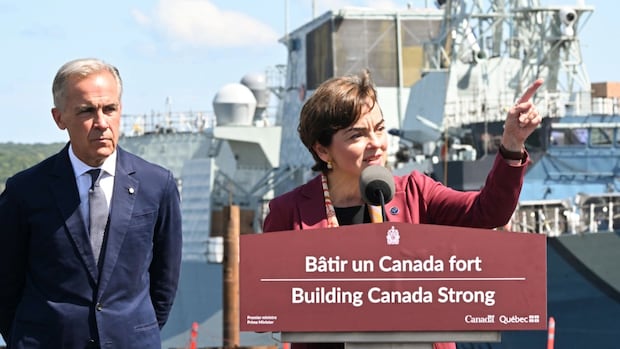
Premier Christine Fréchette made the comments at the Davie shipyard in Lévis, Que., on Monday. Ottawa unveiled $11 billion in funding to build six new icebreakers in partnership with Quebec’s shipbuilding industry.
Fréchette, who is preparing for a provincial election campaign, described the occasion as a remarkable day for Lévis.
She emphasized that the contract will help safeguard the province’s economic independence and generate high-quality jobs, including positions for welders and technicians.
According to Carney, the contract will sustain 5,000 jobs throughout the construction phase.
The icebreakers will be constructed in accordance with the federal government’s “Buy Canadian” procurement policy and will utilize Canadian steel, as stated by Carney’s office.
This announcement follows the recent collapse of trade negotiations with the United States and comes as President Donald Trump has issued new threats of tariffs against Canadian industries.
Earlier this year, Ottawa disclosed an initial $19.6-million contract awarded to Davie under the national shipbuilding strategy to design the six new Polar Class 3 icebreakers.
The Coast Guard is undergoing a significant fleet renewal, with the national shipbuilding strategy projected to oversee the delivery of a total of 88 new vessels by the year 2045.